Wood
Products Trade
North America
Europe
South America
Asia
Forests of the World
Australia
Brazil
Canada
Chile
China
Finland
Germany
Indonesia
Japan
Korea
Mexico
Russia
United Kingdom
Oregon's Forests
Forestry
Links |
Overview
After North America, Europe is the second biggest consuming region
for forest products. By 2010, Europe will account for one third of
world forest products consumption.
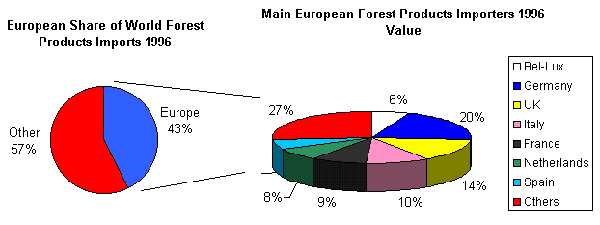
Most European forest products trade is with other European countries.
This is in contrast with N. America, which is a major supplier to other
regions, and Asia, which imports much of its forest products from outside
Asia.
Source: FAO Yearbook of Forest Products
Within Europe, Germany is
the main consuming country and the world's third largest forest products
importer. The United Kingdom
is fourth.
Source: FAO Yearbook of Forest Products
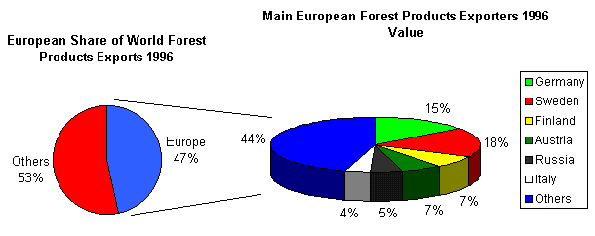
On the production side, Sweden,
Germany and Finland dominate European forest products exports.
Lumber
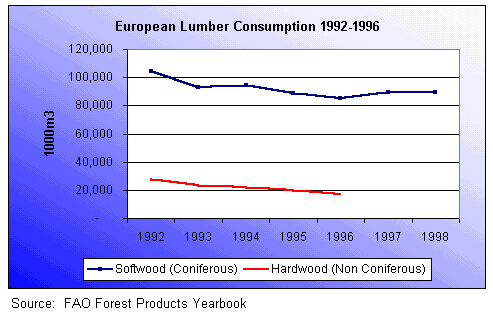
Softwoods account for 80% of lumber consumed in Europe. Softwood
lumber consumption in Europe has traditionally followed economic
growth, at half the GDP rate. Production continues to grow faster
than consumption, prompting manufacturers to seek new export markets,
such as Japan and the US.
Hardwood lumber consumption has
20% share by volume but 30% share by value. Most hardwoods go to furniture
and flooring.
European hardwood lumber consumption has suffered
a long-term decline. Particleboard (PB) and Medium Density Fiberboard
(MDF)
have taken away market share in shop lumber, and environmental
boycotts have diminished tropical wood demand. There were slight
gains in 1998 and 1999, reaching 17 million m3. Hardwood lumber
production is also expected to enjoy a small recovery in 1999.
Woodbased Panels
Consumption of woodbased panels is expected to continue to expand
by 2% in 1999 to reach a new record of 46.3 million m3. Production
is also set to increase significantly, especially in MDF and OSB.
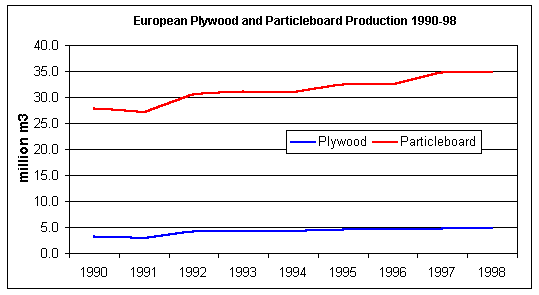
Particleboard is by far the biggest panel market in Europe. Production
is expected to grow 5.2% in 1998 and 2.6% in 1999, reaching 29
million m3. Most of this goes to furniture, shelving, and other
laminated end-uses. Among producing countries, Germany, France,
the UK and Poland will see big increases. Scandinavia is not a
particleboard producer.
Most of Europe's particleboard
production is consumed within Europe. The value of particleboard does not
generally warrant the
high cost of long-distance freight outside of Europe.
Source: FAO Yearbook of Forest Products
Although MDF competes with particleboard, and has taken some
market share from particleboard, particleboard has not died out
the way some analysts predicted. Manufacturers use MDF is certain
applications and particleboard in others.
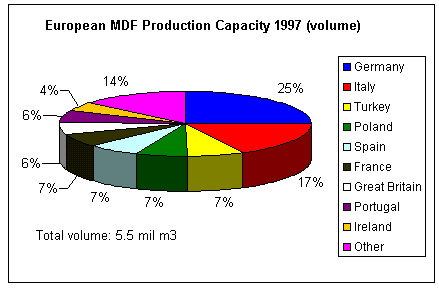
European MDF production,
which now represents 70% of total fiberboard production in Europe, grew
nearly 20% in 1998. Production is concentrated
in Germany and Italy.
Several new production lines will
come on line by 2000, raising production capacity to 10 million m3.
There is concern about where
all this new supply can be absorbed.
Source: FAO Yearbook of Forest Products
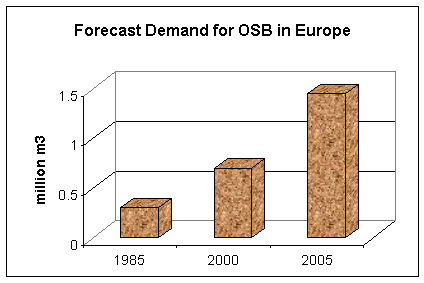
European OSB production has grown rapidly in the last two years.
Although the OSB market is currently small, it is likely that OSB
will gain market share as new housing code changes allow structural
applications for OSB.
Comparatively cheap, OSB in Europe has
already taken some market share from US softwood plywood imports.
Sweden and Finland
Sweden is the world's third largest forest products exporting
country and Europe's largest. Finland is the second biggest forest
exporter in Europe. Together they account for a quarter of European
forestry exports.
Over 75% of Swedish forest production is
exported, mainly to the European Union (EU). More than 80% of Finnish products
go to
Europe--75% of this is to Germany, the UK, and France.
1998 was a rough year for Sweden. Several private sawmills went
bankrupt due to a fall in prices and rising raw material costs.
Sweden has 350 major sawmills, producing 15 mil m3 per year. Over
60% of lumber production goes to Europe. The remainder goes to
North Africa, the Middle East and Japan. Swedish lumber exports
to Japan fell in 1998, but are expected to grow in the next few
years as the Japanese economy recovers and shows a preference for
European lumber.
Finland is third--after Sweden and Germany--in
lumber production. Nearly all lumber is pine or spruce. Most pine
goes to higher value-added
processing, such as moulding. Three-quarters of Finland's lumber
production is exported, mainly to Europe. 9% goes to Egypt, 6%
to Japan. Lumber exports are forecast to be flat in 1998 and 1999.
Source: FAO Yearbook of Forest Products
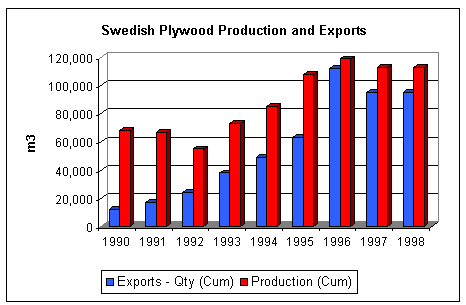
Swedish softwood plywood exports grew 450% between 1990-97, reaching 77,000m3.
This is expected to rise slightly in '98 and '99. Nearly all of this production
is from one company.
Source: FAO Yearbook of Forest Products
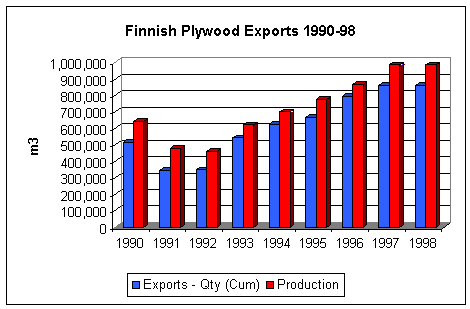
Finland is Europe's leading plywood producer and exporter. Half
is softwood, half is hardwood.
Finnish softwood plywood production
grew by 344% between 1990-97, reaching 400,000m3. The 1998 production level
is expected to reach
435,000 m3 and to 440,000 m3 in 1999. Almost all plywood production
is exported. The two biggest Finnish companies account for half
of production.
Birch is the traditional raw material for
Finnish plywood. Spruce is also growing in use. Capacity has increased
substantially with
new softwood sawmills in 90's. The increased capacity is likely
to eat into the North American share of European markets, although
Finnish plywood is usually more value-added.
Between 1990-97,
Finnish softwood plywood exports rose by over 500% to 384,000m3.
1998 and 1999 levels are expected to reach 400,000
m3. Nearly all of this goes to Europe. Japan is the second most
important market after Europe.
Russia
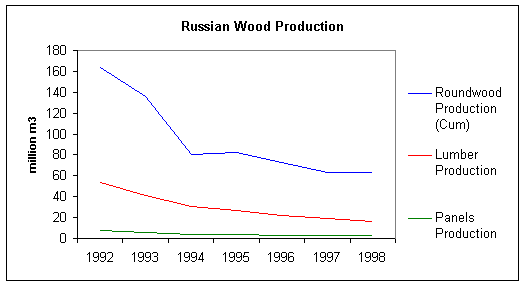
Russia has a huge timber reserve, with one fifth of the
world's softwood forest resources. But since the collapse of Soviet Union,
wood products production has fallen dramatically. Roundwood production
has fallen 60% since 1992.
50% of mills are using obsolete equipment
that are too old. 70% of mills reported losses in 1997.
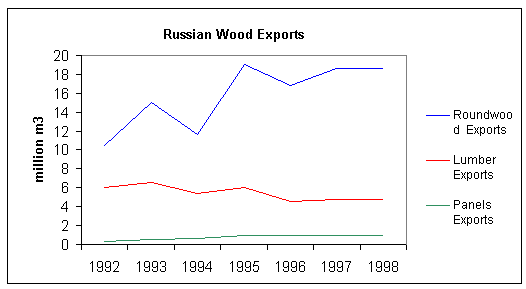
Still,
the weak Russian ruble has made Russian logs and lumber more competitive.
Log and lumber exports grew 10% in 1997, mainly
to Japan and China.
The Russian situation is unlikely to improve
in the short-term. Intensive capital investments are needed to upgrade
existing mills.
Most forecasts about European wood products trade does not include
major changes in access to Russian timber or increased Russian
production.
Source: FAO Yearbook of Forest Products
Trends
The European forest sector will continue to restructure as forestry
companies merge to create large multinational companies. The result
is that there will be fewer companies, but they will be larger
international companies that can compete with North American firms
such as Weyerhaeuser and Georgia-Pacific. The top 12 European lumber
companies account for more than 50% of all Scandinavian timber
output.
Timber certification--in which wood products are certified
that they are derived from sustainably managed forests--will remain
a key issue for consumers in Europe's most important markets, Germany
and the UK. Europe's leading forestry countries are preparing for
various sustainable forestry and wood products labeling systems.
Finland's wood products certification system has already been accepted
by one of the UK's largest wood retailing chains. This will probably
give them a competitive advantage over US softwood.
European
lumber exports to Asia, especially Japan, will increase as their
high quality old-growth timber, packaged and measured
to Japanese specifications competes favorably against more expensive
US lumber.
Several European countries such as Sweden,
Finland, Germany, Latvia and the UK will have increased timber resources
available
for harvest in the near future. This will increase timber self-sufficiency
for some countries, and probably take some market share from the
US, changing the trade mix within Europe.
|